Patellar Tendinopathy (Jumper's Knee) — Physiotherapy & Shockwave Treatment
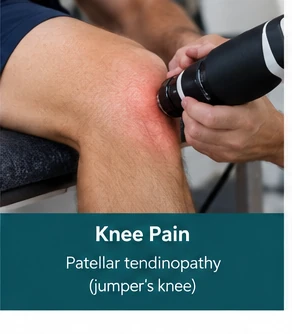
Patellar tendinopathy — commonly called jumper's knee — is a load-related condition of the patellar tendon, the tendon that connects the kneecap (patella) to the shin bone (tibia). It causes pain at the bottom of the kneecap and is characterised by its relationship to load: worse with jumping, squatting, stairs, and sustained sitting, and typically relieved by rest. It can be a particularly stubborn condition that requires patience and the right rehabilitation approach.
Who Gets Patellar Tendinopathy?
Patellar tendinopathy is common in those who engage in explosive, repetitive loading activities — basketball, volleyball, football, squash, padel, athletics, and weightlifting are all high-risk sports. It also occurs in recreational exercisers who have recently increased their training load or introduced new exercise modalities involving jumping or heavy squatting.
It is more common in men than women, and tends to present in active individuals between the ages of 15 and 40.
Why Does It Happen?
Patellar tendinopathy arises when the cumulative load placed on the patellar tendon exceeds its capacity to adapt. The tendon tissue undergoes reactive and eventually degenerative changes, losing its normal ordered structure and becoming thickened, disorganised, and painful. Unlike inflammatory conditions, these changes persist because the tendon is not effectively repairing itself — it is "stuck" in a non-healing state.
Contributing factors include rapid increases in training volume, inadequate recovery, hard training surfaces, and insufficient lower limb strength relative to training demands.
Physiotherapy and Exercise Rehabilitation
The foundation of patellar tendinopathy treatment is a progressive tendon loading programme. The most evidence-supported approach is heavy slow resistance training (HSR) for the patellar tendon — specifically, slow, heavy knee extension and squat-based exercises that progressively load the tendon within a tolerable range. This type of loading drives tendon adaptation and gradual symptom improvement.
Load management during rehabilitation — modifying or temporarily reducing aggravating activities — is important but does not mean complete rest. Complete rest does not improve tendon tissue quality; appropriate loading does.
Typical rehabilitation programmes take 3 to 6 months for meaningful recovery, which can be frustrating but is important to communicate upfront.
Shockwave Therapy for Patellar Tendinopathy
For cases that have not responded adequately to a well-structured, progressive loading programme over 3 months or more, shockwave therapy (ESWT) may be considered. At Lambert Sports Clinic, shockwave for patellar tendinopathy is always delivered alongside an ongoing rehabilitation programme — it is not a standalone procedure.
Clinical evidence for shockwave in patellar tendinopathy is supportive, with studies demonstrating improvements in pain and function when shockwave is combined with exercise rehabilitation. A typical course involves 3 to 6 weekly sessions from £90 per session.
Shockwave for jumper's knee: Initial assessment + first treatment from £90. Follow-up sessions from £70. Suitability determined at individual assessment. Available at our Surbiton clinic 6 days a week.
Return to Sport
Return to full sport after patellar tendinopathy should follow a structured, criteria-based progression rather than a simple time-based approach. Your physiotherapist will guide you through progressive reloading, monitoring your response and adjusting the programme accordingly.
Book an Assessment for Knee Tendon Pain
HCPC physiotherapists · Physio + shockwave options · Surbiton, Kingston & New Malden
Book Your AssessmentDisclaimer: This article is for general information only and does not constitute medical advice. Suitability for any treatment is determined at individual clinical assessment. Outcomes vary. Lambert Sports Clinic is CQC registered; all physiotherapists are HCPC registered.