Shockwave Therapy: Benefits, Evidence and What to Expect
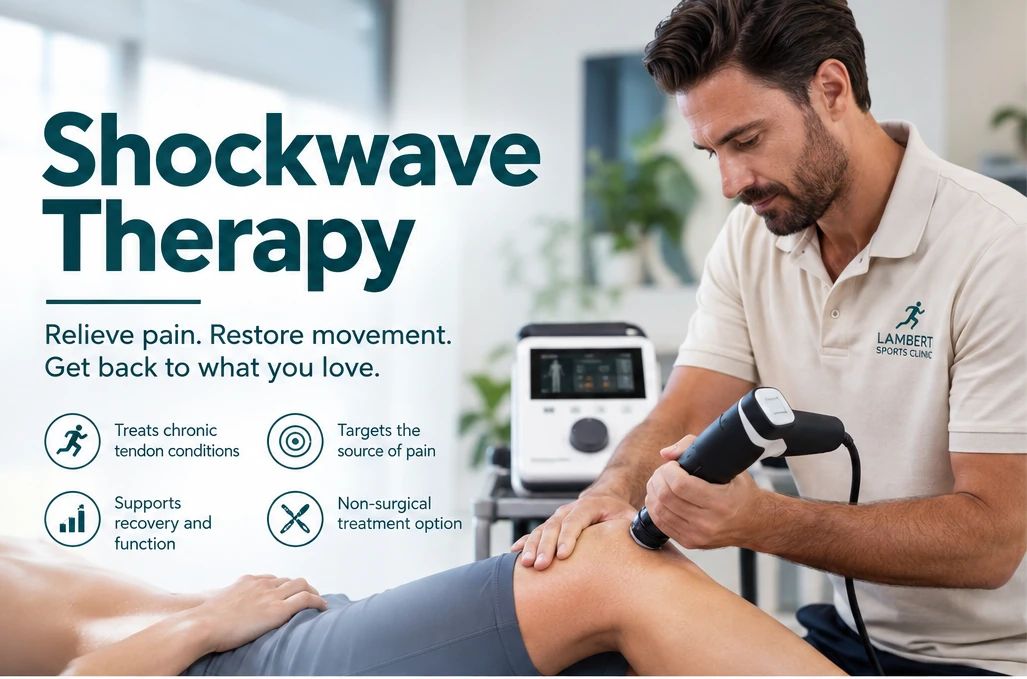
Shockwave therapy has become a recognised part of physiotherapy practice for selected persistent tendon conditions. But understanding what it is, what the evidence shows and what to realistically expect can be difficult when searching online. This article aims to provide a clear, balanced overview — covering how the treatment works, which conditions it may be considered for, what the clinical evidence shows and its limitations, and what patients can realistically expect.
What Is Shockwave Therapy?
Shockwave therapy uses acoustic pressure waves — pulses of mechanical energy — directed at specific areas of the body using a handheld applicator. Despite the name, the treatment does not involve electrical shocks. The waves are mechanical in nature, produced by a device and transmitted into soft tissue through direct contact.
In physiotherapy, shockwave is used primarily for persistent tendon conditions — those that have not resolved through rest, activity modification and initial exercise rehabilitation alone. The treatment is delivered by a qualified physiotherapist following a thorough clinical assessment to determine whether it is appropriate for the patient and condition in question.
It is important to understand that shockwave therapy is not a standalone treatment and is not appropriate for every patient. At Lambert Sports Clinic, it is always delivered as part of a broader physiotherapy programme that includes exercise rehabilitation and progressive loading — the foundation of effective tendon management.
How Might Shockwave Therapy Work?
The exact mechanisms by which shockwave therapy may exert its effects are not fully established, and research in this area is ongoing. Several hypotheses have been proposed:
- Modulation of pain signalling: High-energy acoustic pulses may temporarily alter the pain signalling activity of nerve fibres in the treated area.
- Stimulation of tissue repair processes: Some research suggests that shockwave may stimulate cells involved in connective tissue repair, though the clinical significance of these findings is debated.
- Effects on calcifications: For conditions involving calcium deposits — such as calcific shoulder tendinopathy — shockwave may help to break down or disperse calcific material.
It is worth noting that the biological effects observed in laboratory settings do not always translate clearly into clinical outcomes, and the precise reasons why some patients respond positively to shockwave therapy while others do not remain an active area of research.
⚕️ At Lambert Sports Clinic: Shockwave therapy is always combined with a physiotherapy assessment and a personalised rehabilitation programme. It is not offered as an isolated treatment without clinical evaluation.
Potential Benefits for Selected Patients
For appropriately selected patients, shockwave therapy may offer a number of potential benefits when combined with physiotherapy. It is important to note that these represent possible outcomes rather than guaranteed results, and that individual responses vary considerably.
- Pain reduction: Some patients with persistent tendon pain report reductions in symptoms following a course of shockwave therapy, particularly those with plantar fasciitis or Achilles tendinopathy.
- Improved function: Alongside exercise rehabilitation, some patients experience improvements in movement and daily function.
- Non-surgical option: Shockwave may be considered as part of conservative management before exploring surgical interventions, where clinically appropriate.
- Complement to rehabilitation: When combined with progressive loading exercises, shockwave may support the rehabilitation process for some patients.
Conditions Where Shockwave May Be Considered
Shockwave therapy is most commonly considered for persistent tendon conditions — often referred to as tendinopathies — that have not adequately responded to initial conservative management. Common presentations assessed for shockwave at Lambert Sports Clinic include:
- Plantar fasciitis (plantar heel pain): One of the most frequently treated conditions. There is reasonable supporting evidence for shockwave in persistent plantar heel pain, though outcomes vary.
- Achilles tendinopathy: Both mid-portion and insertional presentations may be considered, typically alongside progressive calf loading programmes.
- Lateral elbow tendinopathy (tennis elbow): Shockwave may be considered for persistent cases, though the evidence in this area is more variable than for some other conditions.
- Patellar tendinopathy (jumper's knee): Selected presentations of persistent patellar tendon pain may be considered for shockwave as part of a physiotherapy programme.
- Calcific shoulder tendinopathy: There is some evidence supporting the use of shockwave for calcific deposits in the rotator cuff, though assessment is required to determine suitability.
Clinical assessment is always required before treatment. Shockwave is not appropriate for every patient or every tendon condition.
What Does the Evidence Show?
The evidence base for shockwave therapy has grown substantially over the past two decades, though it is not without its limitations and inconsistencies.
For plantar fasciitis, a number of randomised controlled trials and systematic reviews have found evidence suggesting that shockwave therapy may be more effective than placebo for persistent cases. However, the quality of studies varies, and not all reviews reach consistent conclusions on the magnitude of benefit.
For Achilles tendinopathy, evidence exists for both mid-portion and insertional presentations, though responses differ between the two and between individuals. Most research positions shockwave as an adjunct to exercise rather than a replacement for it.
For tennis elbow, the evidence is more mixed. Some trials show benefit over sham treatment, while others show limited difference. Clinical guidelines in the UK generally position shockwave as a consideration for persistent cases where other approaches have been tried.
In all cases, it is important to recognise that statistical significance in a clinical trial does not guarantee individual benefit, and that patients need realistic expectations about what shockwave therapy may offer them specifically.
Side Effects and Safety
Shockwave therapy has a recognised side-effect profile that patients should understand before treatment begins. Common side effects include:
- Discomfort or pain during treatment
- Temporary redness or bruising in the treated area
- Soreness or aching in the 24–48 hours following a session
- Mild swelling around the treated area
These are generally transient and resolve without intervention. Serious adverse events are rare but your physiotherapist will discuss the relevant risks with you before treatment.
Shockwave therapy has recognised contraindications. Treatment is not appropriate in the following circumstances (this list is not exhaustive):
- Pregnancy
- Blood clotting disorders or anticoagulant therapy
- Treatment over malignancies
- Treatment over active infections
- Certain implanted electronic devices (including pacemakers)
- Treatment directly over growth plates in skeletally immature patients
Your physiotherapist will conduct a thorough screening at your assessment appointment to determine whether there are any factors that would contraindicate treatment.
The Role of Rehabilitation
A critical point — and one that is sometimes overlooked — is that shockwave therapy is most likely to be beneficial when delivered as part of a structured rehabilitation programme, not as an isolated treatment.
The evidence base for exercise rehabilitation in tendinopathy — particularly progressive loading programmes — is substantially stronger than for any physical modality alone. Exercises such as heel raises for Achilles tendinopathy, or foot strengthening for plantar fasciitis, should remain central to any treatment plan.
At Lambert Sports Clinic, shockwave is always delivered within a physiotherapy context. You will receive personalised exercise guidance and a rehabilitation plan at each appointment.
Patient Suitability
Shockwave therapy is not suitable for every patient. Suitability depends on a range of factors including the specific condition, how long symptoms have been present, what treatments have been tried previously, relevant medical history, and the clinician's assessment of likely response.
The best way to determine whether shockwave therapy is right for you is to book an initial assessment with one of our physiotherapists at Lambert Sports Clinic.
Book a Shockwave Therapy Assessment in Surbiton
Lambert Sports Clinic, 380 Ewell Road, Surbiton KT6 7BE · Initial £90 · Bupa patients welcome
Book Initial Assessment — £90