Shockwave Therapy for Shoulder Pain & Calcific Tendonitis
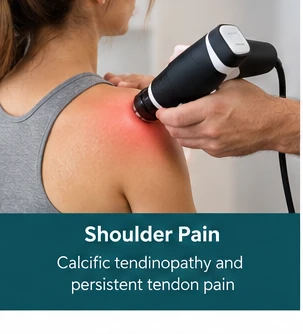
Shoulder pain — whether a persistent ache that limits overhead movement or a sudden-onset acute pain associated with calcific deposits — is among the most disabling musculoskeletal complaints. For two specific shoulder conditions, shockwave therapy (ESWT) has a particularly strong evidence base: calcific tendonitis and rotator cuff tendinopathy.
Calcific Tendonitis of the Shoulder
Calcific tendonitis occurs when calcium deposits form within one of the rotator cuff tendons, most commonly the supraspinatus. The calcium can cause significant pain — sometimes acutely severe — and restriction of shoulder movement. It affects people of all activity levels and is not limited to athletes. Many cases develop without an obvious cause.
Why Shockwave Is Particularly Effective for Calcific Tendonitis
The evidence base for shockwave therapy in calcific tendonitis of the shoulder is among the strongest for any indication. Multiple high-quality randomised controlled trials have demonstrated that shockwave therapy produces significant rates of calcium resorption — the calcium deposits dissolve or fragment — along with clinically meaningful pain reduction and improved shoulder function. In many studies, shockwave therapy outperforms placebo and other non-surgical treatments for this condition.
Shockwave is typically recommended as a first-line treatment for calcific tendonitis before surgical options (such as needling or arthroscopic debridement) are considered.
Rotator Cuff Tendinopathy
Rotator cuff tendinopathy involves degenerative changes in one or more of the rotator cuff tendons, most commonly the supraspinatus. Symptoms typically include pain with overhead movements, discomfort sleeping on the affected side, and weakness with shoulder activities. It is common in those who perform repetitive overhead work or sport.
Physiotherapy — including progressive rotator cuff and scapular strengthening exercises — is the primary treatment. When symptoms have persisted beyond 3 months despite consistent physiotherapy management, shockwave therapy may be considered as an adjunct.
The Treatment Process
At Lambert Sports Clinic, all shockwave for shoulder conditions begins with a comprehensive physiotherapy assessment. This confirms the diagnosis, assesses the location and nature of any calcium deposit (ultrasound imaging may be recommended where available), and establishes suitability for shockwave.
A typical course involves 3 to 6 weekly shockwave sessions. For calcific tendonitis, sessions may be targeted precisely over the calcium deposit identified on imaging. Shockwave is always delivered alongside a physiotherapy rehabilitation programme.
Shockwave for shoulder at Lambert Sports Clinic: Assessment + first session from £90 · Follow-up sessions from £70 · HCPC physiotherapists · Suitability assessed individually
What Does Treatment Feel Like?
The shockwave probe is applied to the shoulder with gel. Most patients describe the sensation as a firm, repeated tapping over the treatment area. Over the most sensitised areas — particularly in calcific tendonitis — this can be uncomfortable, though it is generally well tolerated. Sessions last approximately 20 to 30 minutes.
It is common to experience a temporary increase in shoulder discomfort in the 24 to 48 hours following the first session. This typically settles and is followed by progressive improvement over subsequent weeks.
How Long Before I See Results?
Many patients begin to notice improvement from the second or third session, though the full effect of shockwave — including calcium resorption in calcific tendonitis — develops over several weeks following the treatment course. A follow-up assessment is usually arranged 4 to 6 weeks after the final session to evaluate outcomes.
Is Shockwave Better Than Surgery for Calcific Tendonitis?
Shockwave therapy avoids the risks associated with surgical procedures and does not require anaesthesia or a significant recovery period. Clinical guidelines in several countries recommend shockwave as a first-line intervention for calcific tendonitis before surgical options are considered. At Lambert Sports Clinic we would always encourage patients to exhaust non-surgical options before proceeding to surgery.
Book Shockwave Therapy for Shoulder Pain
Assessment + first session from £90 · Calcific tendonitis & rotator cuff tendinopathy · Surbiton
Book Shockwave — From £90Disclaimer: This article is for general information only and does not constitute medical advice. Suitability for any treatment is determined at individual clinical assessment. Outcomes vary between patients. Lambert Sports Clinic is CQC registered and all physiotherapists are HCPC registered.