Padel Elbow — Is It Tennis Elbow? How Shockwave Therapy Can Help
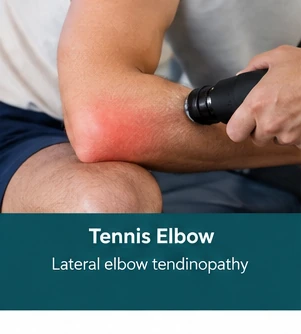
If you play padel regularly and have developed pain on the outside of your elbow that worsens with gripping, lifting, or racket strokes, you may be experiencing what players increasingly call "padel elbow" — a term for lateral epicondylalgia driven by padel's specific movement patterns.
The good news is that this is a well-understood condition with effective treatment options, including shockwave therapy for cases that prove persistent.
Padel Elbow vs Tennis Elbow — Is There a Difference?
Clinically, padel elbow and tennis elbow describe the same underlying condition: lateral epicondylalgia, which involves changes in the tendons that attach the forearm extensors to the lateral epicondyle — the bony prominence on the outside of the elbow.
The term "padel elbow" has emerged because padel's unique characteristics create a distinct injury pattern. The padel racket is shorter and has a solid perforated face rather than strings, which transmits vibration differently to a tennis racket. The enclosed court keeps the ball in play longer, increasing total shot volume per session. The wrist-heavy technique used for glass wall shots places specific loading on the wrist extensors and their attachment at the elbow.
The result is the same pathology, but potentially with different contributing factors that need addressing in the rehabilitation programme.
Symptoms of Padel Elbow
- Pain on the outer side of the elbow, sometimes radiating into the forearm
- Tenderness to touch over the lateral epicondyle
- Pain with gripping — shaking hands, opening jars, lifting a kettle
- Pain during or after padel, particularly backhand strokes and wall shots
- Weakness in grip strength in more significant cases
Why Does Padel Cause This?
Lateral epicondylalgia is fundamentally a load-related tendon condition. The extensor tendons at the elbow are asked to repeatedly absorb force during every shot. When the cumulative load exceeds the tendon's capacity to adapt — whether due to sudden increase in playing frequency, poor racket technique, an ill-fitting grip size, or insufficient recovery — the tissue undergoes changes that produce pain and reduce function.
In padel specifically, playing multiple sessions per week on fast-paced club formats, combined with the heavy wrist loading of glass wall shots, is a common driver.
How Is It Treated?
Stage 1: Load Management and Exercise Rehabilitation
Most cases of lateral epicondylalgia respond to a progressive tendon loading programme combined with temporary modification of aggravating activities. This does not necessarily mean stopping padel entirely — often a structured reduction in frequency and volume, combined with exercise, is the most effective approach. Your physiotherapist will guide this based on your specific presentation.
Stage 2: Adjunct Treatments
Depending on assessment findings, additional treatments may include manual therapy, soft tissue work, and review of grip size and technique. A forearm brace or counterforce strap may also be recommended as a temporary load management strategy during play.
Stage 3: Shockwave Therapy
Shockwave therapy (ESWT) for lateral epicondylalgia is considered when symptoms have been present for three months or more and have not adequately responded to well-applied conservative management. Shockwave involves delivering acoustic energy pulses to the affected tendon, which is thought to stimulate a healing response in the tissue.
The evidence base for shockwave therapy in lateral epicondylalgia is positive, with multiple randomised controlled trials and systematic reviews supporting its use in chronic cases. At Lambert Sports Clinic, shockwave is always combined with an ongoing exercise rehabilitation programme rather than used in isolation.
Shockwave for padel elbow at Lambert Sports Clinic: Assessment + first shockwave session from £90. Typically 3–6 sessions are recommended, spaced one week apart. Suitability determined at individual assessment.
How Many Shockwave Sessions Will I Need?
For lateral epicondylalgia, a course of 3 to 6 weekly shockwave sessions is typically recommended, with progress reviewed at each appointment. Many patients notice improvement within the first 2 to 3 sessions, though the full effect of shockwave develops over several weeks as the tissue remodelling process occurs.
Will I Need to Stop Playing Padel?
This depends on your specific presentation and is guided by your physiotherapist. In many cases, a structured continuation of padel with load management is preferable to complete cessation, which can make return to play more difficult and does not address the underlying issue. Your physiotherapist will advise on what level of activity is appropriate at each stage of your recovery.
Preventing Padel Elbow
Key prevention strategies include: choosing an appropriate racket weight and grip size (seek advice from a padel professional), warming up the forearm and shoulder before play, building playing volume gradually rather than jumping to multiple sessions per week, incorporating wrist and forearm strengthening exercises into your training, and allowing adequate recovery between sessions.
Book Shockwave Therapy for Padel Elbow
Assessment + first treatment from £90 · HCPC physiotherapist · Surbiton, Kingston, New Malden
Book Shockwave — From £90Disclaimer: This article is for general information only and does not constitute medical advice. Suitability for any treatment is determined at individual clinical assessment. Outcomes vary between patients. Lambert Sports Clinic is CQC registered and all physiotherapists are HCPC registered.