Shockwave Therapy for Tennis Elbow
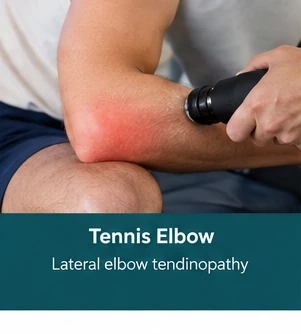
Tennis elbow — more accurately called lateral elbow tendinopathy or lateral epicondylalgia — is a common condition characterised by pain on the outer side of the elbow. Despite its name, it affects far more people who have never played tennis than those who have. It can be a persistent and disabling condition, and many patients find themselves trying multiple treatments before finding an approach that helps.
Shockwave therapy is sometimes considered for lateral elbow tendinopathy, particularly for persistent cases. This article explains the condition, the evidence for shockwave therapy, and how it fits within a physiotherapy programme.
What Is Tennis Elbow?
The muscles that extend the wrist and fingers attach to a bony prominence on the outer side of the elbow (the lateral epicondyle) via a common tendon. Lateral elbow tendinopathy involves degenerative changes and pain at or near this attachment point.
It is strongly associated with repetitive forearm and wrist movements — common in manual work, typing, gripping tools, and some racket sports. It affects men and women roughly equally and is most common between the ages of 35 and 55.
Causes and Symptoms
The underlying changes in lateral elbow tendinopathy are thought to involve failed tendon repair processes rather than acute inflammation — similar to other tendinopathies. Overuse and cumulative loading are the most common contributing factors, though in some cases there is no obvious precipitating activity.
Typical symptoms include:
- Pain and tenderness on the outer side of the elbow
- Pain that worsens with gripping, lifting or repetitive wrist movements
- Difficulty with everyday tasks such as carrying bags, opening jars or shaking hands
- A gradual onset that may initially seem minor before becoming more persistent
Physiotherapy Treatment
Physiotherapy is the primary management approach for lateral elbow tendinopathy and should include:
- Load management: Identifying and modifying activities that are aggravating the tendon.
- Exercise rehabilitation: Progressive wrist and forearm strengthening, particularly eccentric and isometric exercises targeting the extensor muscles.
- Activity and ergonomic advice: Guidance on modifying repetitive tasks, grip technique and workstation set-up where relevant.
- Manual therapy: Specific joint techniques around the elbow and cervical spine may be used in some presentations.
Like most tendinopathies, lateral elbow tendinopathy often follows a prolonged course and requires consistent engagement with rehabilitation over weeks to months.
The Evidence for Shockwave Therapy in Tennis Elbow
The evidence base for shockwave therapy in lateral elbow tendinopathy is more mixed than for some other conditions — particularly plantar fasciitis — and this is worth being clear about before considering treatment.
A number of randomised controlled trials have been conducted, with inconsistent results. Some trials have found that shockwave therapy produces greater improvements in pain and function compared with sham treatment. Others have found little or no difference between active shockwave and placebo in this particular condition.
Systematic reviews on the topic have generally found the evidence to be of low to moderate quality, with significant variation between individual studies in terms of patient selection, treatment parameters and outcome measures. Some reviews conclude that shockwave may have a role for persistent cases; others are more cautious.
Clinical guidelines in the UK do not universally recommend shockwave for lateral elbow tendinopathy, though some position it as a consideration for persistent presentations where conservative management has been inadequate.
Patients should understand this uncertainty before proceeding with treatment — shockwave for tennis elbow is not a proven or guaranteed treatment.
When Is It Considered at Lambert Sports Clinic?
Given the mixed evidence, shockwave therapy for lateral elbow tendinopathy is typically considered when:
- Symptoms have been present for several months
- An appropriate exercise rehabilitation programme has been followed consistently
- Other conservative approaches have not produced adequate improvement
- Clinical assessment indicates potential suitability
It is not appropriate for every patient with tennis elbow, and a thorough assessment at Lambert Sports Clinic will inform whether it is worth considering in your case.
Other Conservative Treatment Options
It is worth noting that lateral elbow tendinopathy has a relatively favourable natural history — many patients recover with time and appropriate rehabilitation without the need for additional interventions. Other conservative options that may be considered in appropriate cases include:
- Counterforce bracing (tennis elbow straps), which may provide short-term symptom relief for some patients
- Wrist splinting in selected presentations
- Corticosteroid injection — though evidence suggests this provides short-term benefit at the cost of worse long-term outcomes for some patients
Surgical referral is rarely required and is typically only considered after prolonged failure of conservative management.
When to Seek Assessment
If you have had persistent elbow pain for more than a few weeks, particularly on the outer side of the elbow, and especially if it is affecting your daily activities or work, a physiotherapy assessment is a sensible first step. Accurate diagnosis is important — not all outer elbow pain is lateral elbow tendinopathy, and a thorough assessment will help to identify the most appropriate management approach for your presentation.
🎾 At Lambert Sports Clinic: Tennis elbow is assessed thoroughly before any treatment, including shockwave therapy, is recommended. Exercise rehabilitation forms the core of our management approach.
Book a Tennis Elbow Assessment in Surbiton
Lambert Sports Clinic · 380 Ewell Road, Surbiton KT6 7BE · Initial £90 · Bupa patients welcome
Book Initial Assessment — £90