Shockwave Therapy for Achilles Tendinopathy
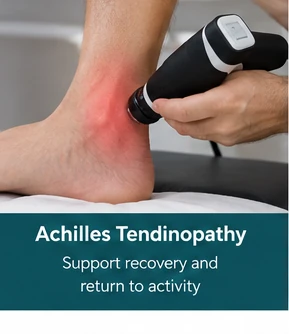
Achilles tendinopathy is a common and often frustrating condition that can significantly affect running, sport and everyday activity. The Achilles tendon — the large tendon connecting the calf muscles to the heel bone — is subjected to considerable repetitive loading, and when the demands placed on it outpace its capacity to adapt, tendinopathy can develop.
Shockwave therapy is increasingly considered as an option for patients with persistent Achilles tendinopathy that has not resolved with exercise rehabilitation alone. This article explains the condition, how it differs between its two main presentations, and what the evidence shows for shockwave therapy as part of management.
Mid-Portion and Insertional Achilles Tendinopathy
Achilles tendinopathy is not a single uniform condition. It is most helpful to think of it in two categories, because they behave differently clinically and may respond differently to treatment:
Mid-Portion Tendinopathy
Mid-portion Achilles tendinopathy involves changes and pain in the body of the tendon, typically 2–6 cm above the heel bone. It is the more common presentation and is strongly associated with repetitive loading — particularly in runners and those who have increased their activity level. Tenderness to palpation in the mid-tendon is characteristic.
Insertional Tendinopathy
Insertional Achilles tendinopathy involves the attachment of the tendon to the heel bone (calcaneus). It often presents with pain and sometimes visible swelling directly at the back of the heel. Bone-related changes (such as a Haglund's deformity or enthesophyte) may be present and are visible on imaging. Insertional tendinopathy can be more challenging to treat, and the response to certain exercises — particularly those that bring the heel below neutral — can aggravate symptoms.
Common Symptoms
Both forms of Achilles tendinopathy typically share the following features:
- Pain and stiffness in the Achilles area that is often worse first thing in the morning
- A warm-up phenomenon — symptoms may improve with gentle activity and then worsen after exercise
- Tenderness on palpation of the tendon or its insertion
- Pain with loading activities such as walking, running or climbing stairs
Load Management and Exercise Rehabilitation
Exercise rehabilitation — specifically progressive tendon loading — is the cornerstone of Achilles tendinopathy management and has a substantially stronger evidence base than any physical modality, including shockwave.
For mid-portion tendinopathy, a heavy slow resistance calf programme (such as the Alfredson or Silbernagel protocols) has good supporting evidence and should form the foundation of any treatment plan.
For insertional tendinopathy, the evidence for specific loading protocols is somewhat less clear, and exercise selection requires care — exercises that stretch the Achilles below neutral may aggravate insertional symptoms.
Load management — temporarily modifying training or daily activities to reduce the provocative load on the tendon — is also an important early component of rehabilitation, alongside gradual progression back to full activity.
When Is Shockwave Considered?
At Lambert Sports Clinic, shockwave therapy for Achilles tendinopathy is typically considered when:
- Symptoms have been present for three months or more
- An appropriate exercise rehabilitation programme has been consistently followed
- Symptoms have not adequately improved despite conservative management
- Clinical assessment supports suitability for shockwave
What Does the Evidence Show?
There is a reasonable body of evidence examining shockwave therapy for Achilles tendinopathy, though the literature is not entirely consistent.
For mid-portion tendinopathy, several randomised trials have found evidence suggesting that shockwave may provide additional benefit over exercise rehabilitation alone in some patients with persistent symptoms. However, effect sizes vary between studies, and placebo effects in physical therapy trials should not be underestimated.
For insertional tendinopathy, the evidence base is smaller and the results more variable. Some studies suggest potential benefit, but clinical guidance on its use in this presentation remains less definitive than for the mid-portion condition.
In both cases, the current consensus position in UK physiotherapy practice is that shockwave may be considered as an adjunct to exercise rehabilitation for persistent cases — not as a replacement for exercise and not as a first-line treatment.
What to Expect from Treatment
Patients undergoing shockwave therapy for Achilles tendinopathy should understand that:
- Treatment may cause discomfort at the time of application — particularly around the insertion point where the tendon meets the bone
- Temporary increased soreness in the 24–48 hours after each session is expected
- Improvement is gradual and typically occurs over weeks, not days
- Not all patients respond to shockwave therapy
- Exercise rehabilitation must continue alongside and following shockwave treatment
Return to Running
Return to running after Achilles tendinopathy depends on symptom response, tendon loading capacity and rehabilitation progress — not on a fixed timeline. Your physiotherapist will guide you on when progressive loading into running is appropriate for your presentation.
Shockwave therapy may support the rehabilitation process, but it does not replace the need for a structured and progressive return-to-running programme.
🏃 At Lambert Sports Clinic: We combine shockwave therapy with a personalised calf and tendon loading programme. Treatment is always based on a thorough clinical assessment.
Book an Achilles Tendinopathy Assessment in Surbiton
Lambert Sports Clinic · 380 Ewell Road, Surbiton KT6 7BE · Initial £90 · Bupa patients welcome
Book Initial Assessment — £90