Shockwave Therapy for Golfer's Elbow (Medial Epicondylalgia)
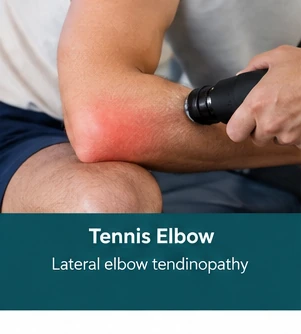
Golfer's elbow — medial epicondylalgia — causes pain on the inner side of the elbow at the attachment of the forearm flexor and pronator tendons to the medial epicondyle. Despite its name, it is not limited to golfers, and is commonly seen in anyone who performs repetitive gripping, throwing, or wrist flexion activities.
For cases that persist despite physiotherapy and load management, shockwave therapy (ESWT) may be considered as an adjunct treatment.
Golfer's Elbow vs Tennis Elbow
The two conditions are anatomically distinct. Tennis elbow (lateral epicondylalgia) affects the extensor tendons on the outer elbow; golfer's elbow (medial epicondylalgia) affects the flexor and pronator tendons on the inner elbow. Both are load-related tendon conditions with similar management principles. Symptoms of golfer's elbow include:
- Pain on the inner side of the elbow
- Tenderness at or just below the medial epicondyle
- Pain with wrist flexion and forearm pronation (turning palm down)
- Pain with gripping activities, particularly in a pronated position
- Occasional numbness or tingling in the ring and little fingers (if the ulnar nerve is irritated)
Who Gets Golfer's Elbow?
Common presentations include golfers (particularly those with a flawed grip or swing technique), padel and squash players, climbers, manual workers, and anyone performing repetitive gripping or throwing. It can also develop in gym users who have rapidly increased their lifting volume.
Conservative Treatment First
As with all tendinopathies, a progressive loading programme for the forearm flexors and pronators is the foundation of treatment. This involves a temporary period of load management followed by graduated tendon loading exercises over 8 to 12 weeks. Most cases improve with this approach, though it requires patience and consistency.
When Is Shockwave Appropriate?
Shockwave therapy is considered for medial epicondylalgia when:
- Symptoms have been present for 3+ months
- A consistent tendon rehabilitation programme has been followed
- Symptoms remain significantly limiting
- Clinical assessment confirms suitability
The evidence base for shockwave in medial epicondylalgia, while less extensive than for lateral epicondylalgia, is supportive of its use in chronic cases.
Note on ulnar nerve: If you have numbness or tingling in the ring and little finger alongside inner elbow pain, it is important that this is assessed before shockwave — ulnar nerve involvement requires careful examination and may affect the treatment approach.
Shockwave Treatment Protocol
At Lambert Sports Clinic, shockwave for golfer's elbow is delivered following a full assessment. A course of 3 to 6 weekly sessions is typical. The probe is applied to the inner elbow with gel and most patients find the sensation manageable, though it can be uncomfortable over the most sensitive area.
A temporary increase in symptoms in the 24 to 48 hours after each session is normal. Exercise rehabilitation continues throughout the shockwave course.
Book Shockwave Therapy for Golfer's Elbow
Assessment + first session from £90 · HCPC physiotherapists · Surbiton, Kingston & New Malden
Book Shockwave — From £90Disclaimer: This article is for general information only and does not constitute medical advice. Suitability for any treatment is determined at individual clinical assessment. Outcomes vary between patients. Lambert Sports Clinic is CQC registered and all physiotherapists are HCPC registered.