Shockwave Therapy for Racket Sport Injuries — Tennis, Padel & Squash
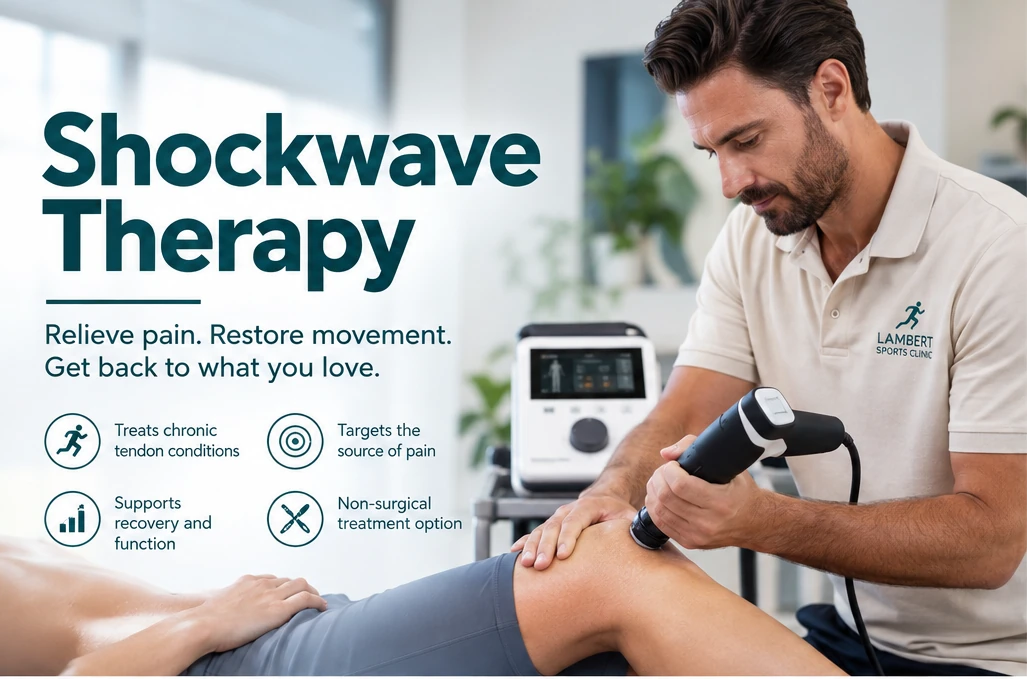
Racket sport players — whether tennis, padel or squash — are among the most common patients to benefit from shockwave therapy (ESWT). The sport-specific loading patterns of racket sports produce characteristic tendon conditions in the elbow, shoulder, and knee that respond well to shockwave when conservative physiotherapy management has not been sufficient.
At Lambert Sports Clinic in Surbiton, shockwave therapy is delivered by HCPC registered physiotherapists as part of a comprehensive treatment programme that always includes exercise rehabilitation alongside the shockwave sessions.
What Is Shockwave Therapy?
Extracorporeal shockwave therapy (ESWT) involves delivering acoustic energy pulses to a targeted area of tissue using a handheld probe. In tendon conditions, shockwave is thought to stimulate a healing response in tissue that has become stuck in a non-healing, degenerative state. It may also have an effect on the nerve fibres that transmit pain, contributing to symptom relief.
Radial shockwave therapy, the form used at Lambert Sports Clinic, delivers pressure waves that spread outward from the probe tip, making it well suited to tendon conditions near the body surface.
Racket Sport Conditions That Respond to Shockwave
Lateral Epicondylalgia (Tennis / Padel Elbow)
This is one of the most extensively studied conditions for shockwave therapy. Multiple randomised controlled trials and systematic reviews support its use in chronic lateral epicondylalgia — typically defined as symptoms persisting for three months or more despite conservative management. Shockwave for tennis and padel elbow typically involves 3 to 6 weekly sessions and is combined with a progressive wrist extensor strengthening programme.
Shoulder Tendinopathy
Rotator cuff tendinopathy — particularly supraspinatus involvement — is a common problem for overhead athletes including tennis and padel players. Shockwave therapy may be considered when shoulder tendinopathy has not responded to physiotherapy and load management within an appropriate timeframe.
Calcific Tendonitis of the Shoulder
Calcific tendonitis, where calcium deposits form within the rotator cuff tendon, is one of the strongest indications for shockwave therapy. The evidence base for shockwave in calcific tendonitis is particularly robust — multiple high-quality studies show significant rates of calcium resorption and pain reduction following shockwave treatment. It is often recommended as a first-line treatment before considering surgical options.
Patellar Tendinopathy (Squash / Padel Knee)
The deep lunging patterns of squash and padel can produce patellar tendinopathy (jumper's knee) — pain at the lower pole of the kneecap with loading activities. Shockwave therapy is considered in cases that have not responded to a progressive tendon loading programme typically lasting 3 to 6 months.
Achilles Tendinopathy
While more commonly associated with running sports, Achilles tendinopathy does occur in racket players, particularly in those who play multiple sessions per week. Shockwave has a strong evidence base for mid-portion Achilles tendinopathy when combined with a structured calf-loading programme.
What to Expect from Shockwave Treatment
Each shockwave session takes approximately 20 to 30 minutes including assessment and exercise review. The shockwave probe is applied to the target area with gel — most patients describe the sensation as a repeated tapping or clicking, which can be uncomfortable over the most sensitised area of the tendon but is generally well tolerated.
Sessions are typically spaced one week apart. It is normal for symptoms to temporarily increase in the 24 to 48 hours following a session before improvement occurs. Most patients begin to notice meaningful improvement within 3 to 5 sessions.
Shockwave at Lambert Sports Clinic: Assessment + first session from £90. Follow-up sessions from £70. Suitability determined at individual assessment. Serving players from Surbiton, Kingston, New Malden and surrounding Surrey.
Is Shockwave Right for My Racket Sport Injury?
Shockwave therapy is most appropriate for chronic tendon conditions (generally 3+ months duration) that have not adequately responded to physiotherapy. An initial assessment at Lambert Sports Clinic will determine whether shockwave is appropriate for your specific presentation, and a clear treatment plan will be agreed before any sessions begin.
Book Shockwave Therapy for Your Racket Sport Injury
Assessment + first shockwave session from £90 · HCPC physiotherapists · Surbiton, Kingston, New Malden
Book Shockwave — From £90Disclaimer: This article is for general information only and does not constitute medical advice. Suitability for any treatment is determined at individual clinical assessment. Outcomes vary between patients. Lambert Sports Clinic is CQC registered and all physiotherapists are HCPC registered.